
A powerful technique for enjoying the present moment

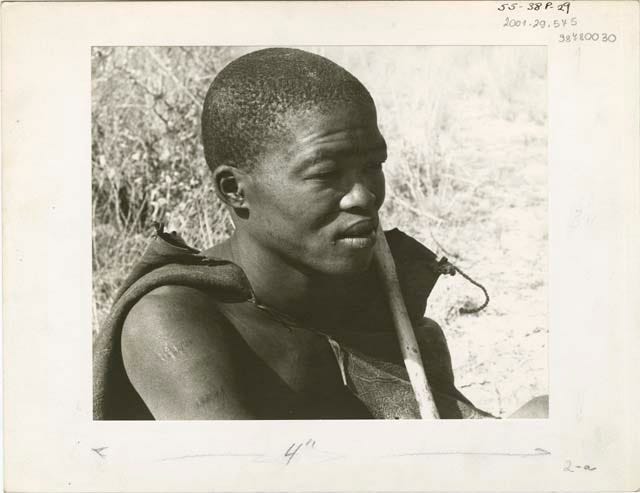
!Gai sitting (1955). Photo by Laurence Marshall. Peabody Museum.1
In 1955, the Marshall family set out into the harsh desert in what is now Botswana. They were there to study the Gwikwe Bushmen hunter-gatherers2, one of the oldest human lineages, who until that time had very limited contact with the world outside the desert. The expedition jolted along for days, and began to wonder if they would find anyone in this apparently empty land, when two Bushmen men appeared at the edge of their camp.
Old Ukwane and the handsome young Gai3 had evaded the expedition, but seeing the trucks so near they thought themselves surrounded and had come to surrender. They had never seen Europeans before and could not properly interpret their body language and facial expressions. They were nervous of these strangers with their pale skin and hulking machines, and of their town-dwelling interpreters. They had heard enough from other bands to know that contact with outsiders usually ended badly. The expedition offered them tobacco and a bucket of water. Gradually their reserve thawed as they talked via the interpreter.
Gai and Ukwane eventually brought the strangers to their camp among the high grass. It was empty. Hearing the trucks, the other eight members of the band had all run away and hidden. Gai cupped his hands around his mouth and called for them to come back. The Marshall’s daughter Elizabeth recounts in her excellent book, The Harmless People, what happened next:
In a short time we heard a rustle in the veld, and a young woman who seemed to be in her early twenties stepped from the bushes. She was, Ukwane said, Gai’s wife, and on her hip she carried a baby, a naked three-year-old who looked at us from his wide eyes fearlessly, then, realizing that we were strangers, buried his face in his mother’s arm. His mother stroked him calmly and came toward us smiling and nodding her head graciously, although a little pulse was hammering in the V of her throat. We learned later that she had been sitting in the bushes very near us, and when she had seen her husband go by she had assumed that everything was all right and had come to greet us4
This woman was called Tsechwe, and her little son was Nhwakwe. They were soon joined by the others. After some initial hesitation, the Bushmen people proved friendly and welcoming, and the expedition began observing their way of life.
Elizabeth became friends with Tsechwe and a sort of aunt to Nhwakwe.
[After returning from an outing away from camp] Tsechwe was so glad to see us that she threw her arms around me and held up her baby for me to kiss. She and I were the only young women for miles around, so there was a bond between us. She often gave me her baby to mind—not an easy job because Nhwakwe was as innocent as he was bold, and I had once taken him from under the wheels of a truck that was about to move. I had carried him to the [camp] for safety, but he hadn’t stayed long; in a short time we had seen the grass moving at the edge of camp and Nhwakwe had appeared once more, this time dragging a toy, having walked the long distance all by himself and having navigated purely by a sense of direction, for the thick grass was high above his head.
The Marshall’s son John, then in his early 20s, documented the expedition on film. “Don’t direct, John,” his father Laurence had told him. “Don’t try to be artistic, just film what you see people doing naturally.”5
Over the course of the almost two month expedition, John captured reel after reel of film. This eventually became the award-winning documentary Bitter Melons, cataloguing the simple day-to-day life of the band. It features Ukwane singing a lament about the wild desert tsama melons, accompanied by the twang of his hunting bow.
Soon after the Marshall expedition left, the world the Bushmen and their ancestors had known for at least 100,000 years began to fall apart. White and Bantu settlers, enabled by modern technology, were pushing deeper and deeper into the Kalahari, taking land for domesticated grazing animals. They commandeered the meager and all-important seasonal water sources that the Bushmen and their game relied upon. They put up fences, drilled bore holes, and killed, captured or forced the Bushmen away into smaller areas and settlement zones. Some Bushmen found work on farms as laborers, but they were often underpaid and abused as little more than slaves.
Southern Africa at this time was roiled by civil and revolutionary wars, and several units drafted or enlisted Bushmen as trackers. Thousands of kilometers of fencing was erected through the desert. This denied migration to the great herds whose bones piled by the tens of thousands against the steel wire. As peace, place and meaning were stripped from the Bushmen, so they were succeeded by alcohol, malnutrition, misery and violence. In the space of a few years the independence of these hardy people, who had thrived for millennia in one of the most unforgiving places on Earth, was replaced with a tenuous hold on the lowest, slipperiest rung of the modern economic system. Many perished.
John Marshall returned to the Kalahari in 1972 and set out to reconnect with Ukwane’s band. But the band was gone. John learned they had been traveling between now-contested water sources but along the way Ukwane had died of thirst.
[When they finally reached the water source] the new farmer wouldn’t let them stay, so they, too, were forced to the Ghanzi Commons. There, Kutera [Ukwane’s wife] and Dasina [Gai’s mother-in-law] died of starvation. Gai, the young man, got a job on another farm where his wife, Tsechwe, was raped by a Tswana man with syphilis—Tsechwe got syphilis and Gai got it too. The farmer didn’t take them to the doctor in Ghanzi for antibiotic treatment (of which Gai and his wife knew nothing). In time, Tsechwe died. Their little boy, Nhwakwe, died too. Gai became more and more ill until he was too ill to work but clung to life because the other workers fed him the scrapings of their three-legged iron pots. In 1972 that was how John found him.
…John had brought a copy of Bitter Melons with him, and also a screen and a projector, as he had planned to show the film to the people who were in it. One evening on the farm, John set up his screen in the veld to show the film to Gai, who sat on his heels in the grass beside the stand of the projector. The farmer brought out a table and chair and a bottle of beer and sat down to watch the film too. Gai had never seen a film. John told him more or less what to expect and sat on his heels beside him.
The film started […] There was Tsechwe again, young and beautiful, and little Nhwakwe, and all the other people living together in the old times. There was Gai himself, with his fine, healthy body. There was Ukwane singing the old songs. Taken off guard, Gai was overcome. He caught John’s hand and began crying. John and Gai held each other’s hands and both wept while the film ran.
It is a human default to take the simple joys and graces of our lives as given. Reams of research tell us that feeling gratitude for what we have is mentally beneficial, and that we should do it more.
“…patients who underwent gratitude interventions experienced greater feelings of gratitude, better mental health, and fewer symptoms of anxiety and depression. Moreover, they experienced other benefits such as a more positive mood and emotions.”6
But like most things researchers tell me I should do more of, I find gratitude exercises hard to do. Not only do I need to remember to do them in the first place, merely listing my blessings seems hollow. I don’t feel them viscerally, like I do when I look at an old photo or watch a home video from Christmas 1999.
“What a simpler time!” I exclaim as the video plays. “Look, this was before my [visible injury or disease]. And hey there’s [beloved old person who is now dead]! Man what I wouldn’t give to go back to that day. I wouldn’t have a care in the world.”
Because that’s the thing: in the present moment I’m always gnawing on some problem or other. Or planning. Or wondering what the future holds. I’m trying to force the effects of my actions today into a shape I think I’ll want tomorrow. I’m always trying to be in the future.
Mostly this is a good thing: we live in a universe with a 4th dimension, and it is lethal to ignore it for too long: if you don’t figure out dinner, there’s no dinner. Do that enough times and you die. We think of our past misfortunes and laugh: ‘all that worry and toil and strife—remember?—how silly it all seems now, ha ha!’ Sure, but only because you know by definition that it turned out alright. You didn’t die; you ate that dinner. But you can only relax with the benefit of hindsight.
“But hold on,” I say, as I watch scenes from the long ago Christmas. “If I’m looking back wishing to be Past Me again, surely some Future Me would probably say the same thing about me right now! How much would Future Me wish to come back to this completely unremarkable moment, before all my [body part] fell out? Before that [societal cataclysm]?
So here’s my technique:
Take a deep breath.
Imagine things are bad for you, way worse than they are right now. Doesn’t have to be too specific: just get the feeling of being sad and angry and hopeless.
Close your eyes for a moment and imagine you’ve just been transported back by a time portal or a genie or something.
Open your eyes.
Think something like: “It worked…I’m here! I’m really back!” Say it out loud if that helps.
Imagine the feeling of relief, of joy washing over you, at this precious gift you’ve been given.
Look around you. Drink in the old decor of the room. This is where you used to live! Notice that each thing is exactly as it was before everything changed. Don’t just feel the breeze outside: imagine you’re feeling again for the first time in years. See the sunlight filtering through the trees like you used to before you went blind, and all these trees were cut down. Flex your muscles and feel how strong you were. Be as specific as possible in what you’re noticing: you’re not looking down at your shoes, you’re looking at these shoes, the ones you used to have.
Revel in the gratitude that everything in this time you’ve been transported to was just fine. That you were alive now. That you still had agency. That everything that time and change took from you is still here.
Don’t tell anyone that you’re a time traveler. Just keep your glowing golden secret to yourself as you appreciate the world. You may find that everyone else seems like they are acting a part in a play and you’re just looking in at the window.
Keep it going by reminding yourself every few minutes that you’re a time traveler, wandering for a short time through this living museum.
And that’s it. Yes, I realize this is basically the plot of the movie About Time. But it really works. You can kick it off in just a few seconds and you can do it anywhere.
Caution: Along with a flood of gratitude, this technique can sometimes trigger intense nostalgia or poignant sadness. Because you realize that these things around you really will all change, that you really will grow older, that these people will all die someday, that this moment is fleeting.
But that’s what makes it so effective.
John Marshall later brought Gai to a town for medical treatment and ensured he was cared for until he recovered. After that, Gai disappears from any record I could find.
John would dedicate much of his adult life to advocating the rights and recognition for these people with whom he had formed deep bonds of trust and friendship.
Even so, Bushmen remain one of the poorest and most marginalized groups in Botswana. To live in their old lands is criminal trespassing, to hunt is now illegal poaching. The old lifestyle has disappeared; many of the new generation spurn it anyway. Meanwhile the Kalahari is increasingly an area of resource extraction by outside interests, as the Australian-owned Motheo open pit copper mine in the area exemplifies.
Things can always be worse. So find a moment to appreciate what you have by going back and viewing it from the eyes of someone who would give anything to be you right now.
Happy time traveling.
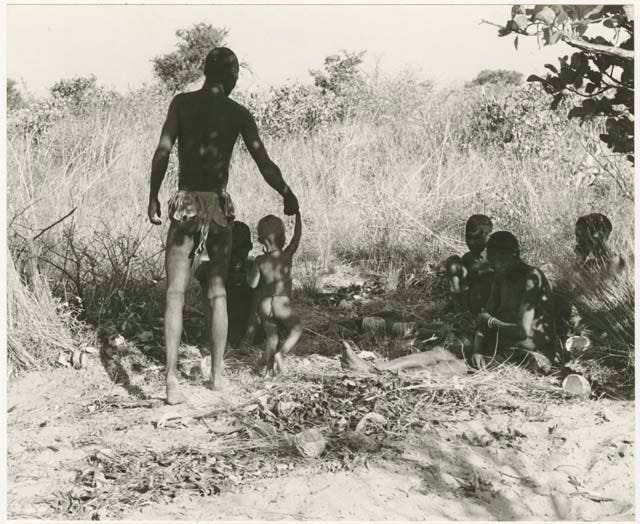
!Gai holding N!whakwe's hand, four people sitting (1955). Gift of Laurence K. Marshall and Lorna J. Marshall. Peabody Museum.7
https://collections.peabody.harvard.edu/objects/details/589862?ctx=4e44d08503d97915a2f62148f8f55467f6280352&idx=2
If you have a problem with the use of the term ‘Bushmen’, please read https://en.wikipedia.org/wiki/San_peoples#Names
In keeping with other writers on these people, I have omitted the symbols like ! and // that indicate the different types of clicks in Bushmen languages
All quotes from the fantastic book The Harmless People, by Elizabeth Marshall Thomas
https://web.archive.org/web/20201007141026/https://newenglandfilm.com/magazine/2005/07/remembering-john-marshall-1932-2005
https://pmc.ncbi.nlm.nih.gov/articles/PMC10393216/
https://collections.peabody.harvard.edu/objects/details/779497